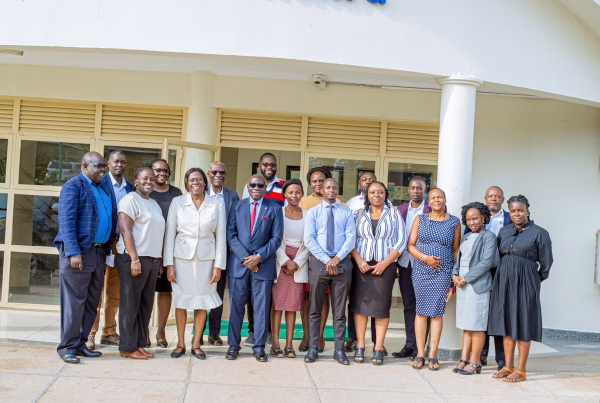


The Joint Clinical Research Centre (JCRC) yesterday proudly welcomed a distinguished delegation from Rotary District 9213, led by District Governor Mr. Geoffrey Martin Kitakule, accompanied by Mr. Abbey Mukiibi and members of the Rotary Club of Kampala Springs under the leadership of President Joseph Ssemuwemba. Their visit marked a significant milestone in the ongoing dialogue around establishing Uganda’s first-ever Bone Marrow Transplant (BMT) facility at the JCRC headquarters in Lubowa.
Upon their arrival, the delegation was warmly received by Dr. Cissy Kityo, JCRC’s Executive Director, who shared a compelling presentation on the urgent need for advanced care options for patients battling complex blood disorders, cancers, and life-threatening conditions like HIV. Dr. Kityo underscored that introducing a BMT facility in Uganda would be a game changer—offering hope, reducing treatment costs, and saving countless lives that are currently dependent on overseas referrals.
The team later toured JCRC’s research and clinical departments, engaging with scientists and clinicians who are at the forefront of medical innovation. District Governor Kitakule commended JCRC’s leadership for its visionary approach, commitment to science, and transformative contributions to healthcare in Uganda.
The Global HIV Burden: A Call to Action
Globally, HIV remains a major public health challenge. As of 2024, the World Health Organization reports that the African Region alone accounts for 26.3 million people living with HIV, making it the most affected region worldwide. Other regions also continue to carry significant burdens, including 4.2 million in the Americas, 3.2 million in Europe, 3.0 million in the Western Pacific, and 610,000 each in South-East Asia and the Eastern Mediterranean.
While antiretroviral therapy has extended life expectancy, the scientific community continues to pursue innovative ways to achieve a complete cure.
One such breakthrough lies in bone marrow transplantation.
Understanding Bone Marrow Transplantation
A Bone Marrow Transplant (BMT)—also known as a stem cell transplant—is a specialised medical procedure in which unhealthy or damaged bone marrow is replaced with healthy stem cells. Once infused into the bloodstream, these cells rebuild a new and functional blood and immune system. BMT falls under the category of Cell Therapy, a fast-evolving field that sits at the centre of global biomedical innovation.
The world’s first successful bone marrow transplant was performed in 1956, opening the door to modern treatment of blood cancers and genetic disorders. In Africa, North African nations such as Algeria, Egypt, Morocco, and Tunisia have long-established BMT units. South Africa operates the only longstanding BMT programme in Sub-Saharan Africa, while Tanzania has recently set up two government-supported BMT units. Uganda, however, still lacks this critical capability, leaving many patients with no choice but to seek costly treatment abroad.
BMT as a Cure: Transforming Lives and Science
Bone marrow transplantation is not just a treatment—it is one of the few medical procedures known to offer a complete cure for several severe conditions. It has been proven to cure blood cancers such as leukemia and lymphoma, and it stands as a potential cure for Sickle Cell Disease (SCD) and even HIV.
The world has already witnessed nine people living with HIV who were cured following bone marrow transplantation. Each of these cases involved individuals diagnosed with a severe blood cancer, who underwent rigorous treatments such as chemotherapy or total body irradiation before receiving donor stem cells. These procedures effectively eliminated both the cancer and HIV from their bodies. These reported cures—recorded in Berlin, London, Düsseldorf, the United States, and most recently in Europe—offer strong scientific evidence that BMT can serve as the foundation for curing HIV in the future.
The Urgency: Uganda’s Heavy Burden of Sickle Cell Disease
Beyond HIV and cancer, Uganda faces a substantial challenge with Sickle Cell Disease, which remains one of the most severe genetic disorders affecting African populations. Globally, an estimated 8 million people live with SCD, with 500,000 new cases each year. More than 75% of these cases occur in Sub-Saharan Africa, and tragically, 50–90% of children born with SCD die before their fifth birthday if they lack early diagnosis and treatment.
Uganda has the fourth-highest prevalence of SCD in Africa, creating an overwhelming need for more advanced treatment options. Establishing a BMT facility at JCRC would offer life-saving care for thousands of children and adults who currently lack access to curative therapies.
Expanding this capability locally would not only increase survival and improve quality of life but would also significantly reduce the financial and emotional burden that families face when seeking treatment abroad.
Why Gene Therapy is the Future
The evolution of medical science is rapidly moving toward gene therapy, a revolutionary approach that targets the underlying genetic causes of disease instead of simply managing symptoms. Gene therapy offers the promise of one-time, curative treatments that can dramatically improve outcomes for conditions like Sickle Cell Disease, hemophilia, HIV, and certain cancers.
More than 32 gene therapies have already been approved for clinical use globally, and the U.S. FDA now receives over 900 new applications every year. Over the past decade, more than 10 clinical trials have been conducted to develop gene therapy solutions specifically for Sickle Cell Disease. This rapid progress highlights why Uganda must invest in infrastructure—such as a BMT facility—that supports gene and cell therapy advancements.
A Transformative Partnership for Uganda’s Future
Rotary District 9213’s engagement with JCRC represents a bold and visionary step toward creating a stronger, more self-sufficient healthcare system in Uganda. By collaborating to establish the country’s first Bone Marrow Transplant facility, Rotary and JCRC have the potential to:
Save thousands of lives through curative treatments
Reduce reliance on costly overseas medical travel
Advance Uganda’s role in scientific innovation
Pave the way for Africa’s first HIV cure through BMT
Provide equitable access to world-class healthcare for Ugandan families
As discussions progress, JCRC remains committed to advancing scientific excellence, strengthening partnerships, and bringing transformative health solutions closer to the communities that need them most.
Together, we can reshape the future of healthcare in Uganda.