


Canada’s commitment to IMMUNEQUITY is a chance to prove that an HIV cure can be designed, from the first day, for the people who carry the heaviest burden of the epidemic.
By Dr Cissy Kityo, Executive Director, Joint Clinical Research Centre, and co-principal investigator, IMMUNEQUITY · 26 October 2026
The Government of Canada committed CAD 24 million to IMMUNEQUITY, a six-year partnership to develop a cure for HIV that is affordable and accessible from the outset. For the Joint Clinical Research Centre, and for Uganda, it is a moment worth pausing on, because of what it makes possible and because of how it was designed.
HIV treatment has advanced enormously, but treatment is not a cure, and the one cure that exists today, through stem-cell transplantation, is complex, risky and priced far beyond the reach of the countries bearing the heaviest burden. More than 40 million people live with HIV, and nearly two-thirds of them are in sub-Saharan Africa. A cure that cannot reach the people most affected is not yet a global solution. The challenge, then, is not only scientific. It is economic, operational and ethical.
Trust is scientific infrastructure
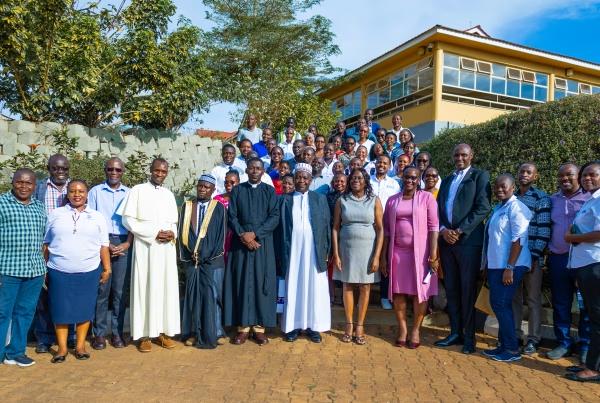
At JCRC, we have learned over three decades that progress in HIV is never built on technology alone. It is built on trust. We helped pioneer one of the world’s earliest PEPFAR-funded treatment programmes, we have conducted more than one hundred clinical trials, and we have built internationally accredited laboratories. But our greatest asset is not a building or an instrument; it is the trust of the communities we serve. In cure research, that trust is infrastructure. It is why IMMUNEQUITY is grounded in community co-design. We are not building a cure for communities. We are building it with them.
Inverting the sequence
What makes this programme different is not only the science; it is the starting point. The usual path in innovation is linear: discover a therapy, optimise it, trial it, and only at the end ask whether it can scale. By then the product is too often too expensive, or too dependent on supply chains that the countries most affected do not control. IMMUNEQUITY inverts that sequence. We co-engineer the therapy and the system to deliver it in parallel. As biomedical scientists develop the cure, frugal biomedical engineers design the diagnostics and delivery tools needed to make it practical where resources are scarce. Access is not an afterthought. It is a design criterion.
The science, in plain language, is a “kick and kill” strategy. HIV survives by hiding inside immune cells, where treatment cannot reach it. First we kick: a targeted agent wakes the hidden virus and forces it to reveal itself. Then we kill: engineered immune cells clear the virus and the cells it has infected. The aim is not only biological efficacy; it is a cure platform that can be manufactured, scaled and afforded where it is needed.
From dependence to sovereignty
This is why I speak of health sovereignty rather than aid. Sovereignty is not isolation; it is resilience, the capacity of a country and a region to protect its people when external support is uncertain, and to give science back to the world rather than only receive it. IMMUNEQUITY will train the next generation of African immunologists, engineers and translational scientists, and it will build manufacturing capacity in Uganda. Beyond a cure, it is a permanent upgrade in capability. It is independence through collaboration.
What this commitment makes possible, and what is still needed
Canada’s investment is the first major commitment to this model, and it answers part of a question I put to the world at the United Nations in July: will we build an HIV cure that is scientifically sound, economically realistic and truly reachable? It does not answer all of it. To bring a cure to those who need it most, we still need three things: financing for access and development; commitment to industrial scale through technology transfer and local manufacturing; and policy harmonisation, so that the path from laboratory to clinic is not delayed by misaligned rules across jurisdictions.
The African perspective has too often been left at the edge of this fight. This partnership places it at the centre. With the right support behind it, IMMUNEQUITY can help deliver a cure not for some, but for everyone, everywhere.
Dr Cissy Kityo-Mutuluuza is Executive Director of the Joint Clinical Research Centre in Kampala and a co-principal investigator on IMMUNEQUITY, a Uganda-Canada HIV cure programme led by Western University and funded through the Government of Canada’s New Frontiers in Research Fund.